How Social Media Algorithms Work in 2026: A Practical Guide
Instagram, TikTok, Facebook and X all run the same kind of prediction machine with different dials. Here is what the 2026 ranking signals actually are, and which reach tactics are just folklore.
Key Takeaways
- Social media algorithms are ranking systems that predict what each person is most likely to engage with, then order posts by that prediction.
- The strongest shared signals in 2026 are watch time, early engagement velocity, relationship strength, and content originality.
- Instagram, TikTok, Facebook, and X run the same prediction logic. They weight the signals differently, most of all for short video.
- Sudden activity spikes, recycled media, and engagement bait damage distribution more often than weak creative does.
- Reach is a feedback loop. Publish, measure retention, adjust the format, then scale whatever already earned attention.
Social media algorithms are ranking systems that decide which posts appear in a person's feed, For You page, or Explore surface, and in what order. They don't like or hate accounts. They estimate how likely one person is to watch, click, comment, share, or come back later, then sort by that predicted value. That's it. The rest is detail.
Most people looking for how social media algorithms work in 2026 want three things: a definition that holds up, the signals that carry weight now, and rules they can apply on Instagram, TikTok, Facebook and X without inheriting outdated folklore.
What Is a Social Media Algorithm?
A social media algorithm is the set of machine-learning models and ranking rules a platform uses to personalize distribution. Chronological feeds still exist as a toggle in some apps. Hardly anyone flips it. The default everywhere is ranked. Meta describes ranking publicly as a prediction problem: estimate how interesting a post will be for one person, then show the highest scores first.
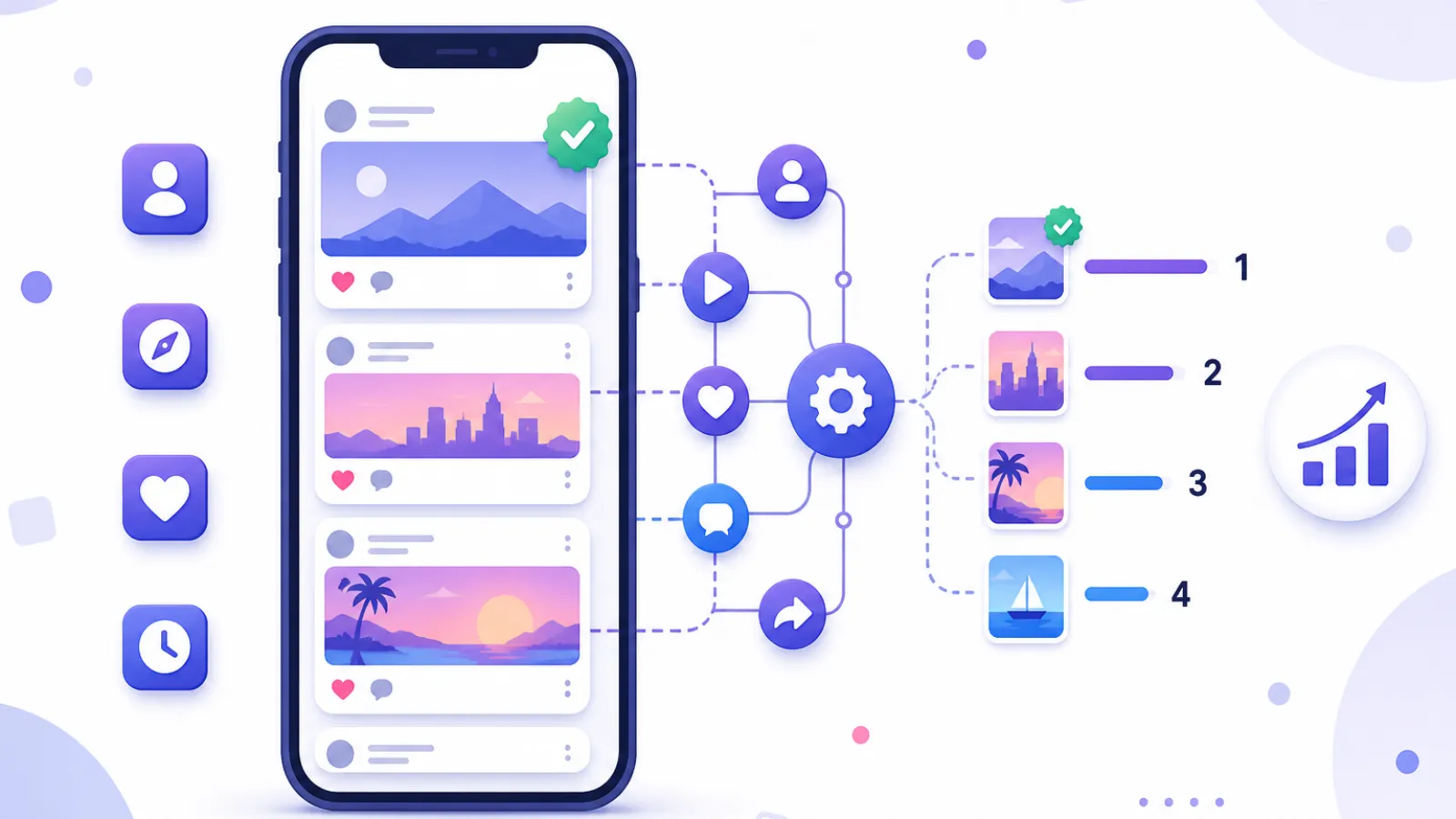
Under the hood it runs in four steps:
- Candidate generation: the system pulls a large pool of posts you might see. Followed accounts, recommended creators, ads, Reels, live clips.
- Scoring: each candidate gets predictions attached. Watch time, like probability, comment probability, share probability, and skip risk.
- Ranking: those predictions collapse into one score, integrity and inventory rules land on top, and the surface gets ordered.
- Feedback: then you watch, swipe, mute or follow, and all of it feeds back in. Not only for you. For everyone the model thinks resembles you.
That loop is why the same video detonates for one audience and stalls for another. The model is personal, not universal.
Core Ranking Signals Shared Across Platforms
Every platform has its own vocabulary for this. Strip the branding off and four families are left. Meta, TikTok and X keep pointing at variants of the same four in public engineering posts.
| Signal family | What the system measures | Why it matters |
|---|---|---|
| Interest / relevance | Topics, formats, creators, and keywords the user already engages with | Keeps random content out of a personalized feed |
| Relationship | DMs, comments, profile visits, follows, tagged interactions | Friends and frequent contacts jump the queue on Facebook and Instagram |
| Engagement quality | Watch time, replays, saves, shares, meaningful comments | Retention and re-shares outweigh cheap likes |
| Integrity / quality | Spam patterns, recycled media, clickbait, policy violations | Can suppress reach even when early clicks look strong |
If it helps, the scoring idea fits on two lines:
rank_score ≈ w1*P(watch) + w2*P(like) + w3*P(comment)
            + w4*P(share) - w5*P(skip_or_hide)
The weights are where platforms differ. A TikTok For You recommendation rewards completion rate heavily. Instagram Stories ranking leans on relationship. An X "For You" timeline mixes followed accounts with predicted engagement from the wider network. Same machinery, different dials.
How Instagram's Algorithm Works in 2026
Instagram doesn't run one algorithm. Feed, Stories, Reels, Explore and Search each get their own ranking system. Adam Mosseri's public explainers still work as a mental model, and his point holds: every surface optimizes for a different user behavior.
- Feed: people and accounts you already care about come first, then recommendations fill the gaps.
- Stories: closeness and recent interaction history, not raw virality.
- Reels: much closer to short-video discovery. Watch time, replays and shares can carry a clip well past your follower graph.
- Explore: almost pure recommendation. Originality and topic match matter more here than follower count does.
In practice, Instagram still pays for early retention. Lose the first 1-3 seconds and the rest of the Reel never gets a fair test. Saves and shares stay stronger quality signals than a passive like, which costs the viewer nothing. Recycled templates and watermarked cross-posts from other apps drag on distribution, as Meta has said in creator guidance for years.
Rebuilding reach after a quiet stretch is its own job. Controlled warm-up of posting cadence matters as much as the creative. The operational half of that ramp is in our Instagram warm-up guide.
How the TikTok Algorithm Works
TikTok's For You feed is the cleanest example of interest-graph ranking in the wild. If early viewers stay and finish a video, the system hands it to people who never followed the creator. TikTok's Newsroom and Creator Portal material describes a mix of user interactions, video information, and device and account settings, weighted heavily toward watch behavior.
What usually moves TikTok distribution:
- Completion rate, plus rewatches, inside the first test cohorts
- A hook and on-screen text that make the topic obvious immediately
- Comments that open a conversation loop. Emoji spam is not that.
- One niche, held long enough that the model can classify the account cleanly
TikTok is also fussier about environment consistency than most creators expect. Change device or network abruptly and it can read as a risk signal about the account rather than the content. That's why operators running several profiles get careful about isolation and proxy hygiene, the subject of our proxy guide for social media automation.
Facebook and X Ranking Logic
Facebook still builds around meaningful social interactions. Posts that get friends commenting, threads inside groups, genuine personal updates: those outrank passive broadcast content most of the time. Reels distribution on Facebook and Instagram shares plenty of DNA. Groups don't. Groups stay a separate discovery engine with their own engagement dynamics.
X (Twitter) mixes followed accounts with algorithmic recommendations in For You. Reply depth, quote activity and dwell can lift a post. Aggressive engagement bait and repetitive link spam invite throttling instead. Account age and trust history still shape how much friction a new or low-history account meets at volume. That one catches people out constantly. For X-specific ceilings, see our X account limits guide for 2026.
Practical Ways to Work With Algorithms (Without Myths)
No secret toggle exists. Nothing "activates" distribution. What exists is a repeatable loop. It looks like this.
- Pick one primary surface. Optimizing a Reel hook and a carousel caption as if they were the same product wastes signal.
- Design for retention first. On short video, the first three seconds decide whether the ranking test continues at all.
- Publish in a stable pattern. Steady cadence with comparable formats teaches the model far more than erratic bursts do.
- Read quality metrics, not vanity metrics. Average watch percentage. Saves. Shares. Profile visits. Not a screenshot of impressions.
- Avoid engagement bait and recycled media. Platforms discourage "comment YES if..." patterns and low-originality reposts out loud. Believe them.
- Keep the account environment clean. Suspicious login patterns, spammy follow/unfollow loops and mass identical actions suppress trust before content quality is even evaluated.
A concrete example. An educational Instagram Reel that holds 55% of viewers to the end and earns saves will usually outrank a flashier Reel that loses half its audience at second two, even when the flashy clip collects more early likes. Retention compounds. Likes alone don't.
Common Myths That Still Waste Time
- "The algorithm shadowbanned me for no reason." There's almost always a reason, and it's boring. Retention slipped, the topic drifted, media got recycled, or an integrity filter caught something. A silent personal vendetta is rarely what happened.
- "Hashtags alone boost reach." They don't. Hashtags help classification. That's where their job ends. No substitute for watch time or conversation.
- "Posting 20 times a day beats the system." It doesn't. Flooding lowers your average quality and teaches the model your content is skippable. The exact opposite of the goal.
- "Buying random engagement fixes ranking." It does the reverse. Low-quality engagement can poison the next candidate tests and invite a spam review.
Worth tracking as the platforms move: Meta's Instagram ranking explainers and engineering posts, TikTok's Creator Portal guidance, and X's public product notes on For You ranking. Creator folklore is fine as a hypothesis. Secondary until a source backs it up.
Frequently Asked Questions
How do social media algorithms decide what I see?
They score the posts available to you by predicted relevance and engagement, then order the highest-scoring items first. Inputs include past watches, relationships, content type and integrity checks. Your own behavior does most of the work.
Is the Instagram algorithm different from TikTok's?
The prediction framework is similar, but the weights differ. TikTok leans harder on interest-graph discovery and on whether people finish the video. Instagram Feed still favors relationships; Reels borrows short-video discovery logic. Same idea, different priorities.
Do follower counts still matter in 2026?
Yes, mainly as a warm starting audience on Feed and Stories. On Reels and For You surfaces, strong retention outgrows a small follower base quickly. A head start, not a guarantee.
Can posting at a "perfect time" beat the algorithm?
No, though timing helps: getting your first cohort online when you publish can improve early velocity. What it cannot do is rescue weak retention. After the first test wave, the creative decides.
Why did my reach drop suddenly?
Common causes are format fatigue, a topic mismatch with your recent audience, lower watch time, reused media, or account-level trust issues after spammy behavior. Compare retention charts with the weeks that worked before assuming a permanent penalty. The answer usually sits there.
Are social media algorithms the same as ads auctions?
No. Organic ranking predicts value for the user, while ads add a commercial auction and delivery system on top of the same inventory. Different objectives, shared surface. Understanding organic ranking sharpens creative for both.
Closing Thoughts
Social media algorithms in 2026 are less mysterious than marketing Twitter needs them to be. They are ranking engines trained on attention. People stay, talk, save and share, distribution widens. People skip, hide and bounce, it narrows. Everything else here is a detail hanging off that mechanism.
Building a multi-account content operation on top of that loop? The account foundation and the environment around it matter more than any posting trick. Our Instagram buying guide is a decent place to start there.
The part almost nobody does: pick one metric, average watch percentage works, and track it week over week for a couple of months before changing anything else. Most accounts don't have an algorithm problem. They have a retention problem nobody has measured.